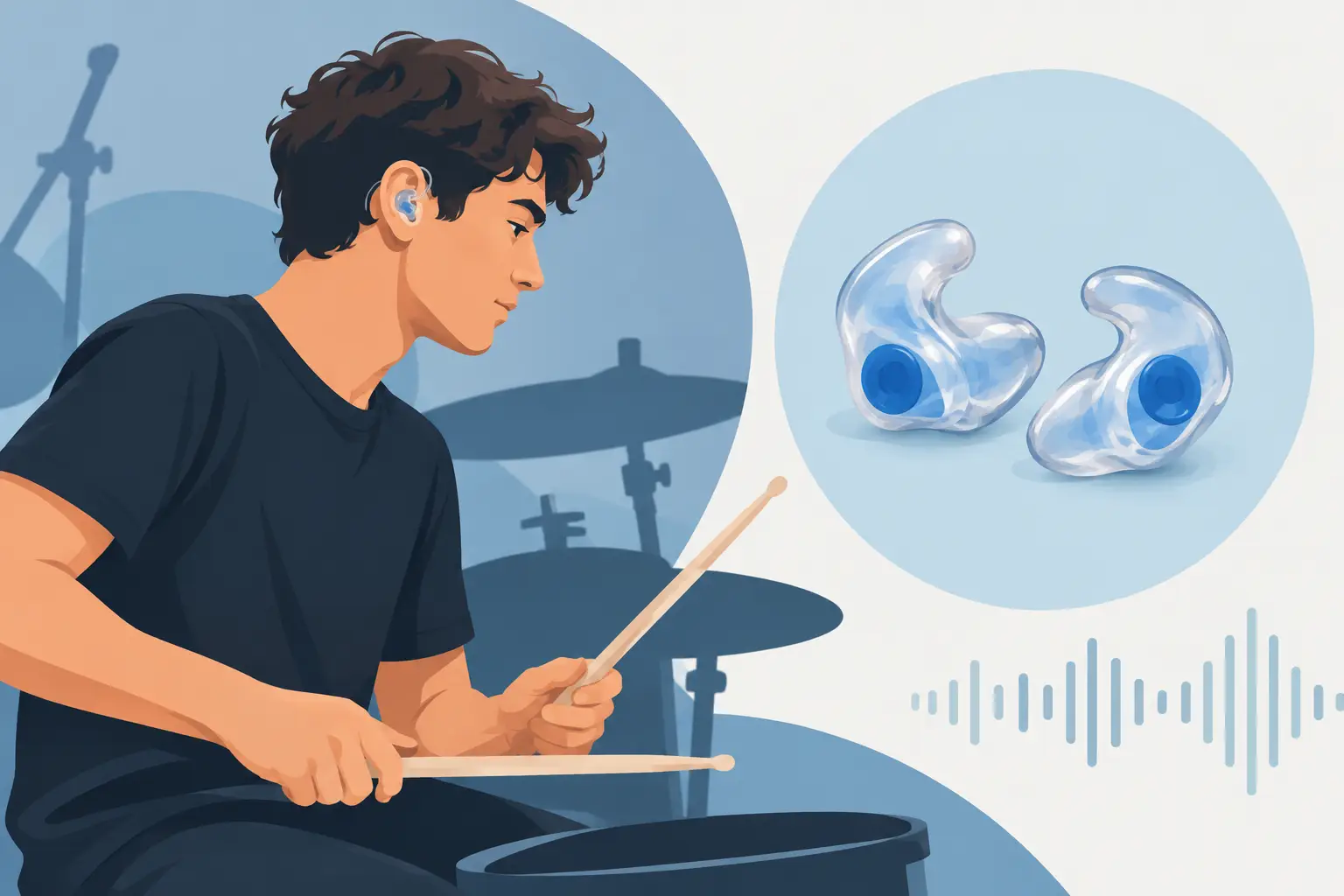
A drummer can leave rehearsal with ringing ears. A vocalist may find that the foldback feels uncomfortably harsh, while a guitarist turns up to compete with the room. These situations are common, but repeated exposure to loud sound can place real strain on hearing. Custom earplugs for musicians are designed to reduce sound to a safer level while helping music remain clear, balanced and enjoyable.
Unlike generic foam plugs, professionally fitted hearing protection is shaped to the individual ear and can be selected around the way you perform, rehearse and listen. The aim is not to make music sound distant. It is to give you a more controlled listening experience, so protecting your hearing becomes realistic to use week after week.
Why musicians need hearing protection
Musicians are exposed to sound in ways that are easy to underestimate. A two-hour rehearsal in a small room, a lively pub gig, teaching in a music classroom or standing beside cymbals can all create substantial sound exposure. The risk is not limited to amplified bands either. Orchestral players, DJs, sound engineers and regular concert-goers may all spend long periods around high sound levels.
Temporary muffling or ringing after an event can be a sign that your ears have been overworked. Repeated exposure may contribute to ongoing tinnitus, difficulty hearing speech in background noise or noise-related hearing loss. Hearing changes can affect confidence on stage as well as everyday communication.
The practical challenge is that musicians need detail. You may need to hear pitch, timing, dynamics, your own voice and cues from other players. Protection that blocks too much sound, or makes it excessively boomy, is less likely to be worn consistently. That is where a custom solution can make a meaningful difference.
How custom earplugs for musicians work
Custom plugs begin with an impression or digital scan of the ear, taken by a suitably trained hearing professional. This creates an earpiece that follows the natural shape of your ear canal and outer ear. A secure fit improves comfort and helps provide a dependable acoustic seal.
Many musician earplugs use an acoustic filter rather than simply blocking the ear canal. The filter is designed to reduce the overall level of sound while retaining more of its natural quality than basic disposable plugs. This is often described as more even or balanced attenuation. In practical terms, music can remain recognisable and detailed, just quieter.
Different filters provide different levels of reduction. The right choice depends on your usual environment, how close you are to the sound source and whether you need to communicate during performances. A classical player in an ensemble, for example, may have different requirements from a drummer playing amplified rock venues. There is no single setting that suits every musician.
Custom protection does not make any setting automatically safe. Very loud sound, long exposure and close proximity to speakers or percussion still matter. It is best viewed as one part of sensible hearing care, alongside breaks away from noise, thoughtful stage positioning and appropriate monitoring levels.
The benefits of a professional fit
Comfort is not a minor detail. If earplugs pinch, loosen when you sing or feel intrusive after twenty minutes, they are likely to remain in their case. A custom fit is made for your ears, which can make it more comfortable for extended rehearsals, performances and travel.
A professional appointment also provides an opportunity to discuss what you actually hear and where you struggle. Perhaps you are a singer who needs clear awareness of your own voice, a drummer experiencing ringing after shows, or a musician returning to live performance after a hearing concern. These details help guide the choice of filter and fit.
At Faringdon Wellbeing Clinic, custom-fit earplugs can be discussed alongside audiology support, so your hearing needs are considered as part of your wider wellbeing. If you have concerns about hearing loss, tinnitus, wax build-up or balance as well as noise exposure, it may be appropriate to arrange a fuller hearing assessment rather than relying on ear protection alone.
When custom protection is particularly useful
Custom earplugs can be a sensible option for anyone who spends regular time around music, but they are especially helpful when generic plugs have not worked well. This may include performers who find foam plugs alter the sound too dramatically, people who need protection several times each week, or those whose ear shape makes standard products difficult to keep in place.
They can also support musicians who perform in several settings. One weekend might involve a small acoustic venue, the next a full-band rehearsal and then a crowded festival. A tailored system with interchangeable filters may offer more flexibility than buying several pairs of disposable plugs. Whether that additional flexibility is worthwhile depends on how often and where you play.
For younger musicians, early good habits can be valuable. Listening fatigue and ringing should not be treated as an unavoidable part of learning or performing. Parents, teachers and band leaders can help by normalising hearing protection as standard kit, alongside instrument cases, leads and sheet music.
What happens at a fitting appointment
A fitting appointment usually starts with a conversation about your music, typical venues, current hearing concerns and previous experience of earplugs. Your ears are checked to make sure they are suitable for impressions or scanning. Wax may need to be removed first if it is blocking the canal or affecting the accuracy of the fit.
The practitioner will then take impressions or use a digital method to capture the shape of each ear. This process should be comfortable, although some people notice a temporary feeling of fullness while impressions are being taken. Your chosen plugs are made from this information and supplied once ready, with guidance on insertion, removal and care.
When you collect them, take time to practise fitting them correctly. Even a well-made plug will not perform as intended if it is not fully seated. It can be useful to try them at a rehearsal before an important performance, giving yourself time to adjust to the change in volume and sound perception.
Choosing the right level of reduction
It is tempting to choose the highest possible level of protection, particularly after an unpleasantly loud event. However, more reduction is not always better for music-making. If you cannot hear enough of the mix, you may remove the plugs halfway through a set or turn up your monitoring unnecessarily.
The most appropriate option is the one that provides useful reduction while allowing you to perform confidently. Think about the loudest and most frequent situations you face, not only the occasional large event. Be honest about whether you need to hear conversation, musical detail or a particular instrument clearly.
If your sound exposure varies considerably, ask whether different filters or a second solution may be useful. Musicians using in-ear monitors may need separate advice, as safe listening still depends on the volume of the monitor mix and the quality of isolation.
Looking after your earplugs and your hearing
Custom plugs should be cleaned as advised and kept in their protective case when not in use. Avoid leaving them in extreme heat, such as a car on a hot day, and check them regularly for damage, changes in fit or blocked filters. Ear shape can change over time, so an old pair may eventually need reviewing or replacing.
Pay attention to symptoms as well as equipment. Persistent ringing, a sudden change in hearing, one-sided hearing difficulty, ear pain, discharge or significant dizziness should be assessed promptly. Do not push objects into the ear canal or attempt to remove impacted wax yourself.
Your hearing is part of your musical skill, not an afterthought. The best earplugs are the ones you understand, can tolerate comfortably and will reach for before the first note is played.