A small wobble when turning to answer the door, stepping off a kerb or reaching into a cupboard can make everyday activities feel less certain. Balance exercises for older adults are not about performing impressive poses. They are about helping you move around your home and community with greater confidence, control and independence.
Balance is a skill that responds to practice. The body continually combines information from the eyes, inner ears, muscles and joints, then makes quick adjustments to keep you upright. With age, periods of inactivity, pain, changes in vision, foot problems or some medicines, those adjustments may become less reliable. The right exercises can challenge this system in a measured, safe way.
Start with safety, not bravado
Choose a clear, well-lit space with a firm chair, kitchen worktop or sturdy rail close by. Wear supportive footwear that does not slip, and avoid loose rugs, trailing leads or pets underfoot. It is sensible to have someone nearby when you first try a new exercise, particularly if you have fallen recently or feel very unsteady.
Use support as much as you need. Holding the worktop with both hands is a successful starting point, not a failure. As you become steadier, you might progress to fingertips, one hand, or no hands while keeping the support within reach. A gentle challenge is useful; feeling frightened, dizzy or unsafe is not.
Stop and seek clinical advice if exercise brings on chest pain, severe breathlessness, new weakness, faintness, palpitations or unusual pain. If you have a condition affecting your heart, nerves, vision or inner ear, or are recovering from surgery or injury, an individual assessment can help you exercise at the right level.
Balance exercises for older adults: a simple routine
Aim to practise two or three times each week. A short, regular session is more valuable than an occasional hard effort. Begin with five to ten minutes and allow time between exercises to settle your breathing. Quality matters more than counting repetitions.
1. Sit-to-stand from a chair
Sit towards the front of a stable chair with your feet flat and roughly hip-width apart. Bring your feet slightly back underneath you, lean your chest forwards and stand up using your legs. Slowly lower yourself back to the chair with control.
If needed, use the chair arms or place your hands on the worktop in front of you. Try five repetitions at first. This exercise strengthens the legs while practising a movement needed for getting up from chairs, the toilet and the car. As it becomes easier, pause for two seconds while standing tall before sitting down.
2. Weight shifts
Stand behind a worktop with both hands resting lightly on it. Slowly move your weight on to your right foot without lifting either foot, then return to the middle and transfer to the left. Keep your upper body upright rather than leaning heavily through your hands.
Continue for 10 shifts each way at a comfortable pace. Once this feels secure, make the movement slightly larger or reduce the pressure through your hands. Weight shifting helps prepare the body for turning, stepping sideways and recovering when the ground is uneven.
3. Heel-to-toe standing
With the worktop close by, place one foot directly in front of the other so that the heel of the front foot is near the toes of the back foot. Hold the position for up to 10 seconds, then change which foot is in front.
You do not need to place the feet in a perfect straight line. A small gap between them is appropriate if that is your safe starting point. This exercise narrows your base of support, much like standing in a queue or moving through a tight space, and can improve control at the ankles and hips.
4. Supported single-leg standing
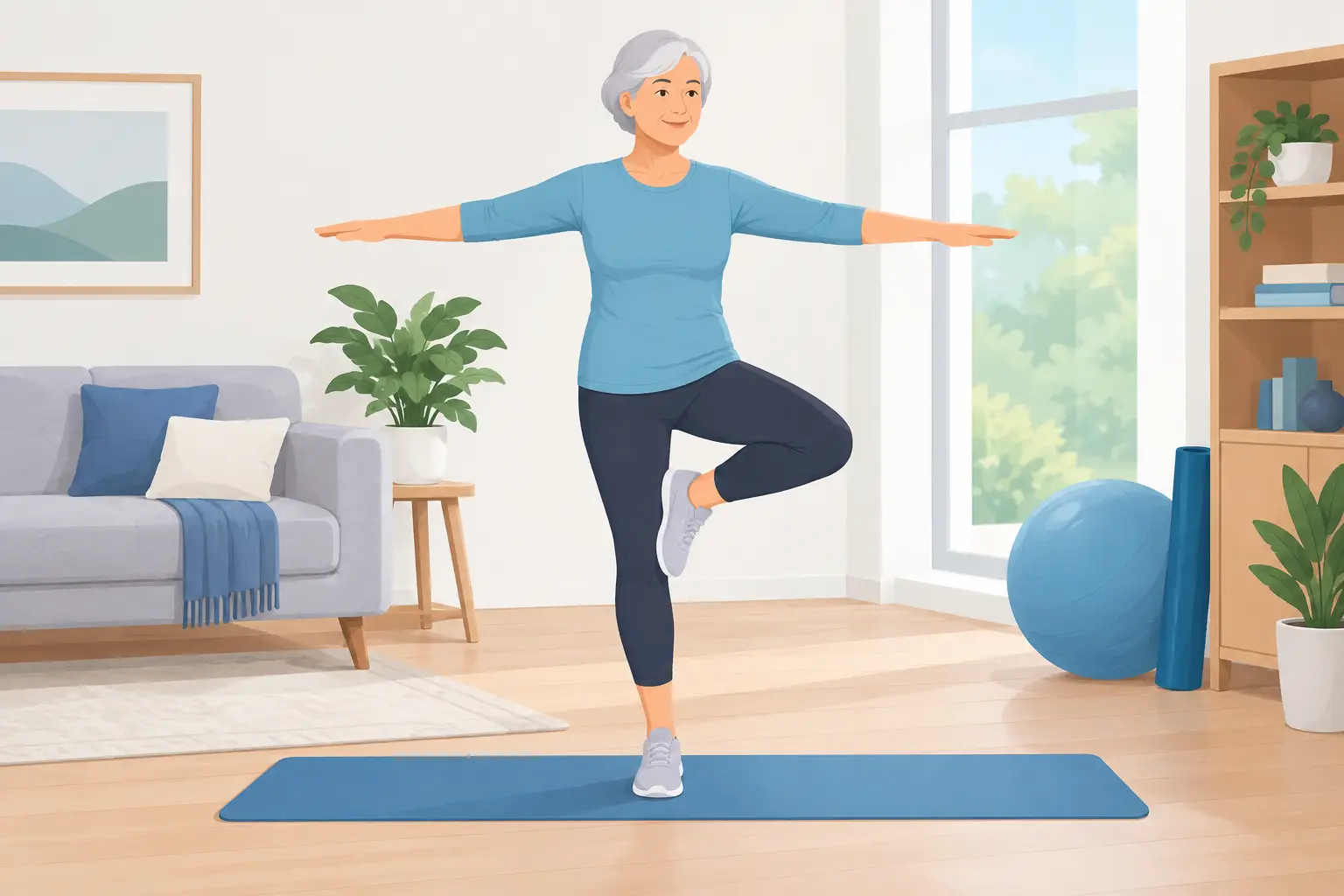
Stand beside the worktop and hold it securely. Shift your weight on to one leg, then lift the other foot only a few centimetres from the floor. Hold for five seconds before placing it down. Repeat on both sides.
Keep the lifted foot low so you can return it to the floor quickly. Build up gradually towards 10 seconds if you are comfortable. Single-leg control is used every time you take a step, climb stairs or step over a threshold, but it should always be practised with support close at hand.
5. Heel raises and toe raises
Hold the back of a chair or worktop. Rise gently on to the balls of both feet, pause, then lower your heels slowly. Next, lift the front of your feet so your toes come up while your heels stay on the floor. Complete eight to 12 repetitions of each movement.
The muscles around the ankles make many of the first corrections when balance is challenged. Keeping them strong and responsive can support steadier walking. If calf pain, foot pain or cramping limits you, reduce the range and discuss it with a suitable clinician rather than pushing through.
How to progress without taking unnecessary risks
The safest way to make an exercise harder is usually to reduce hand support a little, increase the time spent in position, or add a controlled movement such as turning your head slowly from side to side. Do one change at a time. Closing your eyes, standing on an unstable cushion or rushing through movements can be useful in a supervised rehabilitation setting, but is not an automatic next step for home practice.
Balance varies from day to day. You may be less steady if you are tired, dehydrated, unwell, distracted or have not eaten regularly. On those days, return to an easier version, use more support and focus on moving well. Progress is rarely a straight line, and being sensible about a lower-energy day helps prevent setbacks.
Walking is also valuable, but walking alone does not always challenge balance in the same ways as standing on one leg, changing direction or rising from a chair. A rounded plan often includes balance practice, leg-strengthening exercise and an activity you enjoy enough to keep doing. For some people, a guided older adults’ exercise class provides structure and reassurance as well as social connection.
Look beyond the exercises if balance has changed
A new decline in balance deserves attention, particularly after a fall or near-fall. The cause may be more than general deconditioning. Painful joints can alter how you walk, reduced sensation in the feet can affect your awareness of the ground, and hearing or vestibular problems can influence orientation and stability. Poorly fitting shoes, changes in medication, reduced eyesight and low confidence can all play a part too.
This is why a personalised assessment can be more helpful than copying a generic routine. A physiotherapist may assess strength, walking pattern, joint movement and confidence with everyday tasks. A podiatry assessment can identify foot or footwear factors, while an audiology or balance-focused assessment may be appropriate where dizziness, hearing change or vertigo is involved. The most suitable support depends on your symptoms, medical history and personal goals.
At Faringdon Wellbeing Clinic, our multidisciplinary team can help identify the factors affecting your balance and create rehabilitation that feels achievable for you. Coordinated care may be particularly useful where mobility concerns sit alongside pain, foot problems, dizziness or a recent injury.
Make practice part of ordinary life
Attach your routine to something you already do, such as waiting for the kettle to boil or after brushing your teeth. Keep the exercises deliberate rather than trying them while carrying a hot drink, talking on the phone or hurrying out of the house. A note on the fridge or a simple tick on a calendar can make regular practice easier to maintain.
Confidence grows through repeated evidence that your body can respond. Start with the support you need, work at a pace that feels manageable and ask for professional guidance when balance no longer feels like it used to. Each controlled stand, rise and step is a practical investment in the activities that matter to you.