Reaching for a high shelf, fastening a seatbelt or putting on a coat should not require a careful strategy. Yet shoulder pain can make ordinary movements feel uncertain, particularly after an injury, operation or long period of reduced activity. This shoulder rehabilitation guide explains how a structured, individually tailored approach can help you restore movement, strength and confidence without rushing the process.
The shoulder is designed for mobility. It relies on the coordinated work of the shoulder blade, collarbone, upper arm, rotator cuff muscles and the muscles of the neck and upper back. That freedom of movement is useful, but it also means symptoms may have more than one contributing factor. The most effective rehabilitation plan is therefore rarely just a list of exercises.
Start shoulder rehabilitation with the right assessment
Pain in the shoulder may follow a clear event, such as a fall, lifting injury or sporting incident. It can also develop gradually, perhaps after repetitive overhead work, long hours at a desk, changes to gym training or reduced activity. Common diagnoses include rotator cuff-related shoulder pain, tendinopathy, shoulder instability, frozen shoulder, arthritis and pain referred from the neck. Each needs a different emphasis during recovery.
A thorough assessment looks beyond where it hurts. Your clinician may assess the range and quality of your movement, shoulder and neck strength, the position and control of your shoulder blade, work and sporting demands, sleep disruption, previous injuries and any relevant health conditions. This helps establish whether the main priority is settling irritation, regaining mobility, improving load tolerance or preparing for a particular task.
Imaging can be useful in selected cases, but a scan result alone does not tell the whole story. Changes in tendons and joints are common, particularly with age, and do not always explain someone’s pain or ability. Clinical assessment and your day-to-day function should guide decisions about treatment and rehabilitation.
When shoulder pain needs prompt medical attention
Most shoulder problems respond well to conservative care, but some symptoms should be assessed urgently. Seek prompt medical advice if you have severe pain after a significant fall or collision, an obvious change in shoulder shape, sudden inability to lift the arm, marked swelling, fever or a hot, red joint. Chest pain, breathlessness, sweating, nausea or pain spreading to the jaw or arm require emergency care.
You should also arrange assessment if pain is steadily worsening, repeatedly wakes you at night, follows a dislocation, or comes with persistent pins and needles, numbness or weakness in the arm or hand. Early advice can prevent unnecessary delay and ensure the right care pathway.
The stages of a shoulder rehabilitation guide
Recovery is not always linear. A good week may be followed by a short-lived flare after gardening, decorating, a long drive or an enthusiastic return to exercise. This does not automatically mean damage has occurred. It may simply show that the shoulder was asked to do more than it was ready for. The answer is usually to adjust the load, rather than stop all movement.
1. Settle symptoms while keeping the shoulder moving
In the early stage, the aim is to reduce aggravation without making the joint stiff through complete rest. Temporarily modify the movements that are clearly provoking symptoms, such as repeated overhead reaching, heavy carrying or sleeping directly on the painful side. Gentle movement within a tolerable range can help maintain confidence and circulation.
Simple changes often make a difference. Supporting the arm on a pillow while sleeping, taking short movement breaks from desk work and keeping frequently used items at waist height can reduce repeated strain. Pain relief options should be discussed with an appropriate healthcare professional, especially if you have other medical conditions or take regular medication.
2. Restore useful range of movement
When pain and sensitivity allow, rehabilitation generally progresses towards controlled mobility. The goal is not necessarily to force the shoulder through every available degree of movement immediately. Instead, work towards the movement you need for daily life, work, hobbies and sport.
Depending on your assessment, this may include assisted arm raises, gentle rotations, shoulder blade movement and carefully selected stretches. Frozen shoulder, for example, can be painful and slow to resolve, so exercises need to respect irritability rather than aggressively pushing through severe pain. Following surgery or a dislocation, the surgeon’s or specialist’s restrictions take priority because certain positions may need to be protected for a defined period.
3. Build strength and control
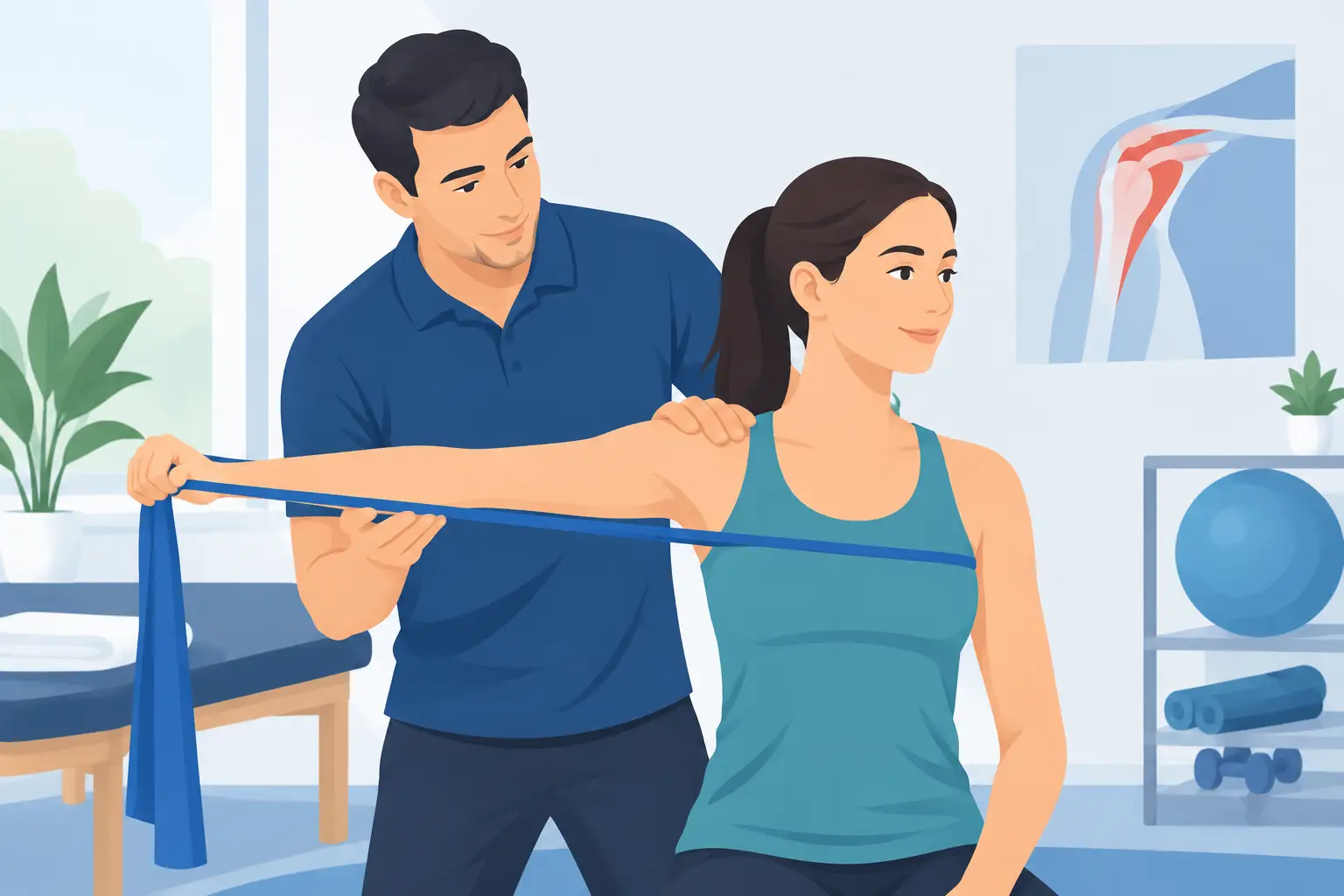
Strengthening is central to many shoulder rehabilitation plans. The rotator cuff helps centre the upper arm in the socket, while the muscles around the shoulder blade provide a stable base for reaching, lifting and pushing. Your programme may start with low-load isometric exercises, where the muscles work without much joint movement, before progressing to bands, light weights and more functional tasks.
Technique matters, but perfection is not the aim. Some muscle effort and mild discomfort can be acceptable during exercise, provided it settles and does not leave symptoms substantially worse later that day or the following morning. Sharp pain, catching, a sensation of instability or a clear loss of function are reasons to stop and seek advice.
Progression should be based on capacity, not just the calendar. Increasing repetitions, resistance, range, speed or frequency all raise the demand. Change one or two variables at a time so you can understand how your shoulder responds.
4. Return to the activities that matter to you
A shoulder that can manage a band exercise may not yet be ready for swimming, tennis serves, manual work or lifting a child repeatedly. The final phase connects clinic exercises with real life. A painter may need sustained overhead endurance, a golfer needs rotational control, and a desk-based worker may need a plan for posture variation and regular breaks rather than simply trying to sit rigidly upright.
A graded return is more reliable than testing the shoulder with one demanding session. Begin with a manageable duration or load, allow recovery time, then build gradually. For sport, this may mean practising lower-intensity skills before returning to full training or competition. For work, it may involve temporary task changes, improved workstation set-up or pacing physically demanding duties.
How much discomfort is acceptable?
This is one of the most common questions in rehabilitation, and the honest answer is that it depends. With long-standing tendon-related pain, a small and manageable increase in symptoms during strengthening can be part of building tolerance. With an acute injury, recent operation or unstable shoulder, the threshold may be much lower.
A useful guide is to monitor the 24-hour response. If symptoms are mild during exercise and settle back to your usual level by the next day, the load is often appropriate. If pain is escalating, sleep is worse or movement is more restricted the following day, reduce the range, resistance, repetitions or frequency. Your practitioner can help you find the right level, particularly where pain has persisted for several months.
Why a whole-person approach can improve recovery
Shoulder pain does not exist separately from the rest of your life. Poor sleep can heighten pain sensitivity. Stress can increase muscle tension and make symptoms feel more intrusive. A busy job or caring responsibilities may limit the time available for exercise. These are not barriers to be judged. They are practical factors that should shape a plan you can realistically follow.
At Faringdon Wellbeing Clinic, physiotherapy, osteopathy, sports and remedial massage, ergonomic assessment and other appropriate services can be considered as part of a coordinated plan when needed. Hands-on treatment may help some people feel more comfortable and move more easily, but it is generally most useful when paired with education, progressive exercise and a clear return-to-activity strategy. The right combination depends on your symptoms, preferences and goals.
Make your plan easier to follow
Consistency usually matters more than doing a long session once a week. Attach your exercises to an existing routine, such as after brushing your teeth or before making an evening meal. Keep the programme focused enough to complete, and tell your clinician if a movement feels unclear, painful or impractical. Rehabilitation should fit around your life, not become another source of pressure.
It can also help to measure progress by function rather than pain alone. Notice whether you can sleep more comfortably, reach a cupboard with less hesitation, carry shopping, work at your desk for longer or return to an activity you have missed. These changes often show meaningful recovery before the shoulder feels completely normal.
A well-planned shoulder rehabilitation programme gives you more than exercises. It gives you a safe route back to the movements that support your work, independence, sport and everyday comfort, at a pace your shoulder can genuinely sustain.